Why More Aspiring Pilots Can Now Choose to Train in India
Aug 03, 2026
PNN
New Delhi [India], August 3: India is now the world's third-largest domestic aviation market, and the growth shows no sign of levelling off. Industry estimates put the requirement at 25,000-30,000 new pilots over the next decade, rising to 30,000-40,000 given India's current aircraft order book of roughly 1,600 planes. Aviation consulting firm CAPA India projects a total demand of 22,400 pilots by FY 2030. India's Union Civil Aviation Minister, Kinjarapu Rammohan Naidu, has spoken of a need for 20,000-plus trained pilots in the near future.
Yet, between 2020 and 2024, approximately 5,700 Commercial Pilot Licences (CPLs) were issued - well below even the near-term target - though a record 1,652 CPLs were issued in 2025 alone, according to DGCA licensing data. By 2025, Indian carriers were resorting to issuing 236 temporary licences to foreign pilots, a stopgap that aviation analysts have described as costly and unsustainable.
Indian carriers have collectively placed orders for well over 1,500 aircraft in recent years as they race to expand capacity, according to manufacturer order-book disclosures from Airbus and Boeing. Thousands of cockpits will need qualified hands within this decade.
For years, a common "solution" was to send aspiring Indian pilots overseas - to the US, Australia, South Africa, or Southeast Asia - at a cost commonly cited in the ₹70 lakh to ₹105 lakh-plus range by aviation training advisories, only to bring them back, put them through a licence conversion process, and hope they stayed. It was expensive for families, inefficient for airlines, and ultimately a borrowed answer to a homegrown problem. One institution decided, in 2007, that India could do better - and set out to prove it.
A Bet on India, Placed Early
When Chimes Aviation Academy (CAA) was founded, India's flying training ecosystem was fragmented and mistrusted. The perception that serious pilot training required going abroad was the belief of the day. Building a world-class Flying Training Organisation (FTO) on Indian soil, in the heartland of Madhya Pradesh, was a contrarian wager.
Eighteen years later, that wager has paid off in a way that reshapes the conversation entirely. Today, CAA stands as one of India's leading Flying Training Organisations, fully approved by the Directorate General of Civil Aviation (DGCA). It has clocked over 2,00,000 flying hours since inception, graduated more than 1,000 alumni now employed across the aviation sector worldwide, and operates a fleet of 33 modern aircraft - one of the most modern and largest training fleets among Indian FTOs. Its cadets have gone on to fly for leading domestic and international carriers.
These are not niche numbers. They represent the steady creation of something India desperately needed: a pipeline of domestically trained, internationally competitive pilots.
What World-Class Training Looks Like Without a Passport
Critics of domestic aviation training in India historically pointed to three gaps: infrastructure, airspace, and consistency of flying hours. CAA's architecture is a direct rebuttal to each.
The Flying Ecosystem. CAA operates across two active airfields - Dhana and Neemuch - both in Madhya Pradesh. The strategic advantage here is significant: Madhya Pradesh offers more than 320 clear flying days a year, meaning training rarely stalls due to weather restrictions. The airfields sit within state-owned government airfields that carry zero commercial traffic - giving cadets unrestricted, dedicated airspace. Night-flying capability at both bases, complete with PAPI-equipped runways, ensures trainees accumulate the full breadth of required flight experience on Indian soil.
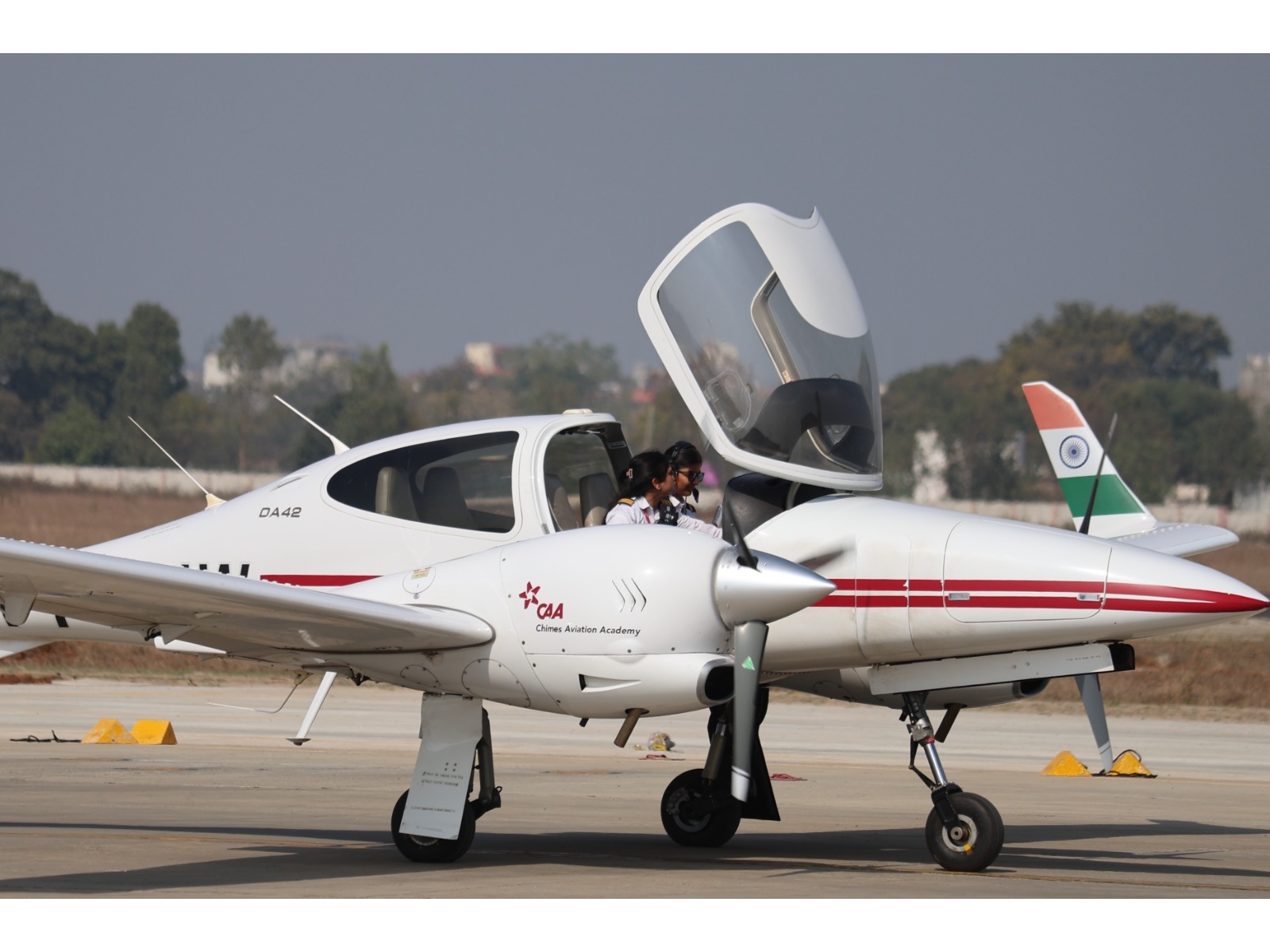
The Fleet. Flying training is only as good as the machines cadets train on. CAA's fleet includes Cessna 172s, Piper Archer DXs, Tecnam P2010s, and Diamond DA42s - all fitted with the Garmin G1000 NXi Glass Cockpit, the same technology environment found in modern commercial airliners. This is not merely a training aid; it's a bridge. A cadet who trains on glass cockpit avionics at CAA transitions more smoothly to a modern commercial jet cockpit than one who trained on analogue instruments overseas and is then expected to adapt. The goal was always to produce pilots who are commercially deployable - not just licensed.
Ground Training. CAA's Ground Training School (GTS) is located in Gurugram, Haryana - a deliberate choice to give cadets access to urban infrastructure while they prepare for DGCA written examinations. The GTS is co-located with CAA's corporate office and hosts an ADAPT Test Centre. Since February 2025, the DGCA has issued licences electronically (EPL), further streamlining the regulatory pathway for India-trained pilots, according to DGCA circulars and subsequent Press Information Bureau releases.
For a long time, the question wasn't whether students wanted to train abroad; it was whether India could offer the same standard of training at home. Today, institutions like CAA have helped answer that question with confidence.
A Structured Cadet Pathway
Perhaps the strongest validation of CAA's training philosophy is its long-standing association with one of India's leading airlines through its cadet pilot program. This program offers a structured pathway from ground school through Commercial Pilot Licence (CPL) training in India, followed by Type Rating, designed to prepare cadets for progression towards the role of Junior First Officer.
More importantly, this demonstrates that aspiring pilots do not need to look overseas for the core stages of their training. Cadets can build their academic foundation, complete their flying training, and earn their CPL in India through a curriculum aligned with airline requirements. This integrated model is precisely what India's aviation sector needs to scale a reliable, India-anchored pipeline of airline-ready talent.
The Economics of Staying Home
The financial argument for domestic training has become increasingly decisive. While program costs vary, aspiring pilots who choose to train overseas often incur significant additional expenses, including international travel, accommodation, visa fees and licence conversion costs - commonly cited by flight-training advisories in the range of roughly ₹35-75 lakh for training in India versus ₹50 lakh to over ₹1 crore abroad, depending on country and school. These can substantially increase the overall investment required to become a commercial pilot.
For a country where aviation aspirants often rely on educational loans, the cost differential between domestic and overseas training is not a minor inconvenience - it is often the deciding factor in whether a career gets off the ground at all. CAA's model has maintained competitive pricing while delivering the kind of safety record and graduate outcomes that historically justified the premium of going abroad. In its 18+ years of operations, CAA has maintained one of the lowest incident rates in the Indian FTO sector - a statistic that, in aviation, speaks louder than any marketing claim.
What 1,000+ Alumni Actually Mean
Numbers can be cited. But the alumni of Chimes Aviation Academy are visible in real cockpits, on real flights. Today, Chimes Aviation Academy alumni fly with leading domestic and international carriers across the industry.
The Bigger Picture: A National Priority Hiding in Plain Sight
India's pilot shortage is, at its core, a training capacity problem - and training capacity is a problem that domestic FTOs like CAA have been solving, one graduate at a time, for nearly two decades. The DGCA's introduction of a biannual FTO ranking system scoring institutions across operational aspects, safety standards, compliance, and student support signals growing governmental recognition that building a robust domestic training ecosystem is a strategic imperative, not just an industry matter, according to DGCA communications reported by Business Standard and ANI.
As of April 2025, the government's UDAN scheme had operationalised 625 routes connecting 90 airports across India, including heliports and water aerodromes, with more than 1.49 crore passengers benefiting from the scheme, according to a Ministry of Civil Aviation statement. Every new route, every new aircraft delivery, every new regional airport that opens its doors creates demand not for pilots trained in Arizona or Queensland - but for pilots trained and licensed in India, ready to fly the length and breadth of the country they grew up in.
The Case, Already Made
India doesn't have to send aspiring pilots abroad for quality flight training. With the right infrastructure, global-standard instruction, and exposure to the diverse flying conditions Indian skies offer, aspiring commercial pilots can build a strong foundation at home. The infrastructure exists. The regulatory framework is maturing. The alumni network is already flying.
Chimes Aviation Academy made that investment nearly two decades ago. The result is over 2,00,000 flying hours logged, more than 1,000 alumni in cockpits across India and the world, and a direct pathway into the airline industry. CAA has demonstrated that aspiring pilots can build a strong academic and flying foundation right here in India.
(ADVERTORIAL DISCLAIMER: The above press release has been provided by PNN. ANI will not be responsible in any way for the content of the same.)